Identifying lawn and garden weeds
Weeds are plants that grow anywhere you don’t want them to. From lawns and flowerbeds to driveways and pavements, they can spoil environments, compete with plants and water and nutrients, and be a real headache to get rid of.
To remove them permanently, different types of weed require different approaches, and the first step is understanding your foe. In this blog, we’ll look at all the most common garden weeds and lawn weeds in the UK, how to identify them, and some pro tips that can help you keep your lawns, gardens and borders weed-free in the long-term.
Common lawn weeds
Removing lawn weeds is a common issue for many gardeners, the toughest job being killing the weeds without damaging the grass. The best way to control lawn weeds is to combine natural weed treatments that improve lawn health with selective weedkillers that target the weeds but not the grass.
But beyond that, there are still some specific characteristics to bear in mind:

Dandelions
Perhaps the most recognisable weed with yellow flowers is the dandelion (taraxacum officinale), which is commonly seen between March and November. While bees and goldfinches love them as a source of food, they self-seed prolifically and can quickly colonise bare patches of soil. The flat rosettes of leaves, with their serrated edges, can smother grass in lawns, while the plants can grow back from any root segments left in the ground.
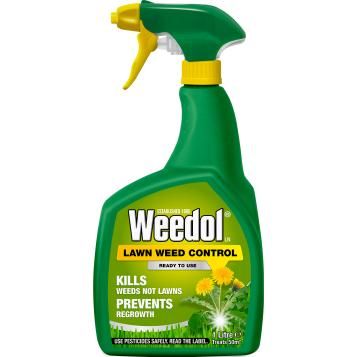
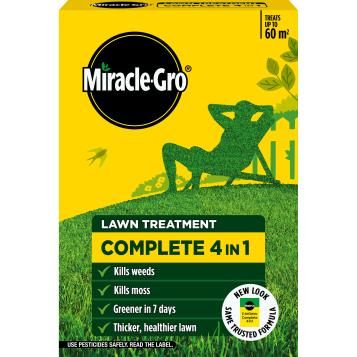
Pro tip: Because they germinate all year round, dandelions can be very difficult to get rid of. Weedol Gun! Lawn Weedkiller can tackle individual dandelions with a handheld spray, while Miracle-Gro Complete 4-in-1 provides more general protection for the lawn as a whole.

Creeping buttercup
Creeping buttercups (ranunculus repens) may look pretty, and be great pollinators for bees and butterflies, but they can spoil the look of a well-tended lawn. From late spring to late summer, their underground runners spread out and, with their three-lobed hairy leaves, form large mats of foliage which can easily crowd out grass if left untreated.
Pro tip: Soil that’s damp or that drains poorly is ideal for buttercups. Manual removal includes raking over them pre-mowing, and digging up individual ones (including runners). Afterwards, Miracle-Gro Evergreen Natural 4-in-1 can encourage thick healthy grass and naturally prevent the growth of new weeds.
White clover, medick and bird’s foot trefoil
These three lawn weeds are all related and can look very similar. The simplest way to tell them apart is by their flowers and seeds. While clover flowers are very popular with pollinators, clover and related weeds can be a problem in lawns, competing with grass for water and nutrients.
- White clover (Trifolium repens) is a perennial weed, well-known for its three-lobed leaves. It produces creamy white flowers from late spring to autumn. White clover spreads by underground stems (runners) as well as seed and can form large mats of leaves that smother grass in lawns.
- Black medick (Medicago lupulina) is an annual or short-lived perennial with similar trefoil (three-lobed) leaves to clover, and rounded yellow flowers from spring to autumn, followed by black seed pods. It forms a low mat of stems and spreads by seed.
- Bird's foot trefoil (Lotus corniculatus) is a perennial weed. Like medick, it has yellow flowers from mid-spring to autumn, but it has five leaves rather than three, with two leaflets near the base of the leaf stalk and the other three at the tip. The flowers are followed by distinctive long, thin seed pods.

Pro tip: Avoid selective weedkillers as these weeds can be resistant to them. Rake them pre-mowing or dig them out by hand, then use Miracle-Gro Evergreen Natural 4-in-1 to promote lawn growth that replaces them.
Daisies

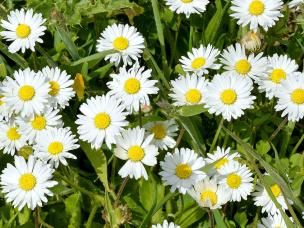
Daisies (Bellis perennis) are one of the easiest lawn weeds to recognise, with their familiar flowers boasting rays of white petals around yellow centres, above flat rosettes of oval leaves with scalloped edges. Daisies spread by both runners and seed, and can gradually form mats of foliage that smother grass.
Pro tip: Dig up individual plants with a hand fork. To cover wider areas, use selective weedkillers like Miracle-Gro Complete 4-in-1 or Weedol Gun! Lawn Weedkiller.

Plantains
There are two common lawn plantains: greater plantain (Plantago major) and ribwort plantain (Plantago lanceolata). The former has large oval leaves, and the latter has longer narrow leaves, but both have distinct veins running the length of leaves from the base, and both produce cone-shaped flowers on long stems.
Their seed pods scatter large quantities of seed on the ground, while the plants themselves compete with grass for water and nutrients.
Pro tip: With shallow roots, plantains are relatively easy to dig out (along with their roots) with a hand fork. A selective weedkiller such as Miracle-Gro Complete 4 in 1 can ease the process if there are large quantities to deal with.

Common mouse-ear chickweed
Mouse-ear chickweed (Cerastium fontanum) is a low, creeping lawn weed, most common in lawn areas that are damp or shady. They have small oval leaves on thin stems, and small white flowers which can appear from mid spring well into autumn. The creeping stems root when they touch soil, gradually forming dense mats of foliage that crowd out the lawn grass.
Pro tip: Small patches can be dug out with a hand fork. For long-term prevention, use Miracle-Gro Evergreen Natural 4-in-1 to encourage thick healthy grass, and aerate your lawn every year.

Yarrow
Yarrow (Achillea millefolium) is a native wildflower with ferny foliage and flat-topped pinkish white flowerheads on upright stems. It spreads by seed and by underground rhizomes, quickly forming mats of foliage that can smother grass. Yarrow is a resilient plant, and often appears in lawns on dry or nutrient-poor soils where it can out-compete the grass.
Pro tip: Yarrow can be resistant to weedkillers, so try digging them out with a hand fork in the first instance, and use Miracle-Gro Complete 4 in 1 as part of a wider strategy of long-term control.
Common garden weeds
Garden weeds that can’t be removed manually can be killed off with weedkiller — if that weedkiller is applied with care. For example, weeds in borders are often best tackled by hand to avoid damage to surrounding plants. If you need to use weedkiller to tackle, remember to cover all neighbouring plants with plastic sheeting to protect them, and always follow the manufacturer’s instructions.
Here’s what you need to know about the most common garden weeds in the UK:

Creeping thistle
Think weeds with purple flowers, and you’re probably thinking of creeping thistle (Cirsium arvense). Often found in borders, this large perennial weed forms clumps of big spiny leaves, with purple-pink flowers in summer on stems that can grow up to a metre tall. The flowers and fluffy, wind-dispersed seed heads, are a good food source for both pollinators and birds. However, creeping thistle can spread rapidly, and competes with other plants for light, nutrients and water; while their lateral roots break easily, they can regrow from root segments, although these tend to be weaker and easier to pull up.
Pro tip: Dig up with a garden fork and get as much of the roots as possible. Deadhead them if flowers are developing, and cut young seedlings off at ground level with a hoe.

Green alkanet
Green alkanet (Pentaglottis sempervirens) is a perennial garden weed that can be mistaken for a foxglove when the plants are small. Its large oval leaves look similar to foxglove leaves but are bristly to the touch and speckled with white spots — these hairy stems and leaves can cause skin rashes, so wear gloves if you handle them.
It produces small blue forget-me-not flowers in summer, and spreads rapidly by self-seeding. Although the flowers are attractive and good for pollinators, green alkanet takes up a lot of space in the border, crowding out other plants, so it should be kept under control if you want a diverse environment.
Pro tip: Use a hand fork for young seedlings and a garden fork for larger plants (including the entire tap root if possible). If they can’t be dug out, cut them down to ground level to weaken them.

Dock
Docks (Rumex ssp.) are perennial weeds with large oval leaves, often with distinct red or white mid-ribs. They have exceptionally long tap roots which can reach up to 90cm, but luckily, only the top 15cm or so of the root can regrow into new plants. Docks have long seedheads on tall stems and produce huge amounts of seed, which can live in the soil for up to 50 years.
Pro tip: The younger the plant, the easier it is to dig them out, so do so as soon as you spot one. Use a garden fork on bigger ones, so you can get as much as the root as possible. Otherwise, use a systemic weedkiller like Roundup Fast Action to kill the roots of the plant (cover surrounding plants with protective sheeting during the spraying).

Hedge bindweed
One of the most common weeds with heart shaped leaves, bindweed (calystegia sepium) has climbing stems that twine around other plants, if left to grow unchecked. Bindweed spreads rapidly with deep underground rhizomes, making it difficult to remove once established, especially as plants will grow back from any segments left in the ground.
Pro tip: The priority is getting as much root out as possible. Use a hand fork to begin with, and if necessary use a hoe to sever the plant at root level. If you can’t remove the whole root, use a systemic weedkiller like Roundup Fast Action (remember to cover surrounding plants with protective sheeting).

Couch grass (Elymus repens), also known as twitch grass, is a type of coarse perennial grass which is generally considered a weed. It has longer leaves than lawn grasses, and instead of clumps of fibrous roots, it produces a network of pale underground rhizomes which enable it to spread rapidly. Couch grass can be difficult to tackle in borders once established, because it grows in amongst the roots of other plants and can regrow from any small segments of root left in the soil.
Pro tip: Dig out individual plants and new shoots as they appear, especially in early spring. Remove as much of the root as possible to prevent regrowth. Don’t dig over the soil in areas where couch grass is a problem, as this can break up the rhizomes, making the problem worse.

Cleavers (Galium aparine) are also known as goosegrass, sticky weed and sticky willie. This annual garden weed develops long sprawling stems with whorls of narrow leaves at intervals along each stem. Small white flowers in summer are followed by small, round seeds that are purple or green. Stems, leaves and seeds are all covered in tiny, hooked bristles that attach to fur and clothing, allowing the seeds to be easily distributed around the garden. If left unchecked, cleavers can spread and smother other plants.
Pro tip: As their roots are shallow, cleavers can easily be pulled up by hand, especially if you roll them into balls so that the stems stick to each other (try not to get loose seeds on your clothes!). Regular hoeing cuts off seedlings at the base before they can get established.

Rosebay willowherb
Also known as fireweed, rosebay willowherb (Chamaenerion angustifolium) is a perennial weed producing tall stems with oval leaves and sprays of pink flowers in summer, followed by seed capsules that produce abundant fluffy seeds which are spread by the wind. Although it is very pretty, it self-seeds prolifically and also spreads via shallow, spreading roots.
Pro tip: Shallow roots mean these can easily be removed with hand or garden forks. Regularly hoeing borders can help cut down seedlings before they get the chance to grow substantially.
FAQs
When should I use weedkiller on common garden weeds?
Using weedkiller depends on several different factors: type of weed, the plants or environment surrounding it, how mature the weed is, and even the weather and the time of year. Different types of weedkiller are better-suited for different jobs, and you can read about them here. Just remember to follow the instructions carefully to keep both yourself and your plants safe!
What should I do if the garden or lawn weeds keep coming back?
If your original treatments haven’t worked, then it might be worth considering a more long-term alternative. For example, if you tried a fast-acting weedkiller in the first instance, then you may want to switch to a slower-acting, but longer-lasting residual weedkiller. Good choices here include Roundup® Fast Action Ready to Use Weedkiller in areas with plants you want to keep, or Weedol® Tough Weed Control in areas not being used.