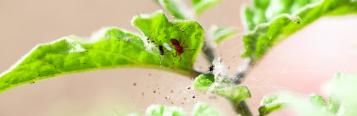
What are spider mites?
Spider mites, often called red spider mites, are tiny sap-sucking plant pests that can cause serious damage to plants. Despite the name, they're usually pale yellow-green with two dark spots (overwintering females can turn orange-red, which is where the name comes from), and they're extremely difficult to see until populations build up and they begin producing their characteristic fine webbing.
They belong to the same group as spiders and ticks (arachnids), meaning they have eight legs rather than six like insects. The most common species in Australian gardens is the two-spotted mite (Tetranychus urticae) - 'glasshouse red spider mite' is a UK name, and there are several other spider mite species too. They feed by piercing plant leaves and sucking out sap, which weakens the plant over time.
Because they are so small, often less than 1mm, they are usually identified by the damage they cause, such as speckled leaves, yellowing, and fine webbing, rather than by seeing the mites themselves.
What do spider mites look like?
Red spider mites are perhaps the smallest of the common sap-feeding insects, being less than 1mm in size. They are so small you need a magnifying glass to identify them accurately and they are often easier to identify by examining the damage done to plants (see below). Despite their size, red spider mite damage can be extensive.
They like it warm and dry, which is why they can commonly be found indoors, on house plants or in conservatories or greenhouses. If the summer is dry and warm they can also be found outside from March to September where they can become a pest on beans, strawberries, raspberries, currants, roses and other ornamental plants.
For most of the year, red spider mites are not red at all – they are yellowish-green with two dark blotches towards the head. They turn red in the autumn and winter resting period. The larger, fast moving, bright red mites you sometimes see in the garden are actually red velvet mites and are not harmful to plants at all.
What are early signs of spider mites?
Leaves first develop a fine, pale mottling and become dull green. As the red spider mite infestation progresses leaves turn yellowish white which can be mistaken for a mineral deficiency but look underneath the leaf with a magnifying glass and you will see the tiny red spider mites and spider mite eggs. Large colonies produce a characteristic fine silk webbing between leaves and stems. Plants shed their leaves, leaving just young leaves at the shoot tips.
How to get rid of spider mites (step-by-step)
Step 1: Isolate affected plants
Move infested plants away from others immediately to prevent the mites from spreading. This is especially important in late summer before the females start to look for sheltered places to spend the winter once the temperature drops.
Step 2: Inspect and confirm
Check the undersides of leaves for webbing, speckled damage, or tiny moving dots.
Step 3: Spray with water
Use a strong jet of water to wash mites off leaves, especially underneath where they cluster.
Step 4: Apply a treatment
Use insecticidal soap, neem oil, or a suitable miticide to target remaining mites. Repeat applications every few days as needed.
Step 5: Increase humidity
Spider mites prefer dry conditions, so increasing humidity around plants can help slow infestations.
Step 6: Remove heavily affected growth
Prune off badly damaged leaves or stems to reduce mite populations and improve plant recovery.
Step 7: Monitor regularly
Continue checking plants weekly and repeat treatment if mites reappear, as infestations can return quickly.
What are the best treatments for spider mites?
You’ll find there are many methods of red spider mite control. Here we’ve listed a few different options, ranging from cultural and biological to chemical.
Natural treatments
Natural methods include spraying plants with water, using insecticidal soap, or applying neem oil. These options are effective for light to moderate infestations and are safer for beneficial insects.
Consider biological treatment, such as using another species of mite that eats red spider mites. Phytoseiulus persimilis works best before the infestation becomes too big and needs a high daytime temperature to be effective. You can also try using it on outdoor plants in high summer. Avoid using an insecticide as it will also kill the biological control.
Chemical treatments
For severe infestations, targeted miticides or insecticides may be required. These products are designed specifically to control mites. You will need to apply it several times to break the red spider mite’s life cycle.
Before you treat red spider mite on fruit and vegetables, always check that the insecticide is approved for use on edible crops. To protect bees and pollinating insects do not apply to plants when in flower. Do not use where bees are actively foraging. Do not apply when flowering weeds are present.
Preventative measures
Keeping plants healthy is key to prevention. Check susceptible plants frequently from October onwards, and through the warmer months, so you can act before a red spider mite infestation takes hold. Regular watering, reducing dust on leaves, and maintaining humidity can make plants less attractive to spider mites. Remove any weeds growing in or around the plant because they may act as hosts for the mite.
FAQs
What’s the fastest way to get rid of spider mites?
The fastest way is to wash plants thoroughly with water and follow up with insecticidal soap or neem oil, repeating treatment every few days until the mites are gone.
How do you prevent spider mites?
Keep plants well-watered, increase humidity, and regularly clean leaves. Inspect plants frequently so infestations can be treated early.
Do spider mites live in soil?
Spider mites mainly live on plant leaves, especially the undersides, although they can overwinter in plant debris or nearby surfaces.
Can spider mites kill plants?
Yes, severe infestations can weaken plants significantly and may eventually kill them if left untreated.