
The different types of daffodils
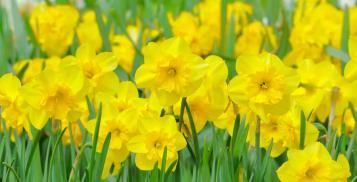
Narcissus, commonly known as the daffodil, is divided into as many as thirteen groups, usually classified by the flower type. Different varieties work in different parts of the garden.
For garden borders, planted in small groups or large drifts among shrubs and trees, taller, large-flowered varieties will give the best impact although smaller varieties near The front of a border or in a windy site will work well too You might add extra interest with a two-toned, double-flowered cultivar.
Dwarf varieties are particularly suitable for containers. The cheerful Narcissus ‘Tête-à-tête’, only growing to 20cm (8 inches) tall, blooms from late winter, and brightens border edges and hanging baskets. Meanwhile, the small-flowered wild daffodil Narcissus pseudonarcissus is a graceful option to naturalise in lawns.
Jonquil daffodils, also short in stature, are valued for their multi-headed blooms and their strong fragrance. They are most at home in a dry and sunny location, such as a rock garden. Also appreciated for its sweet-smelling flowers is the ‘Tazetta Paperwhite’ daffodil, often forced indoors for early flowers at Christmas.
Finally, ‘Pheasants Eye’ daffodils, whose blooms don’t emerge until late April, extend the flowering season of daffodils to the end of spring.
When to plant narcissus bulbs and daffodils
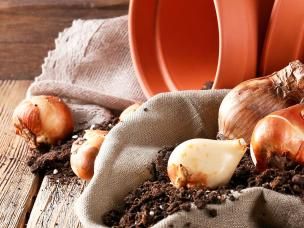
Daffodil and narcissus bulbs are best planted in September, while the soil is still reasonably warm from the summer just gone. As long as the weather is mild enough that the ground is not frozen or waterlogged, daffodil bulbs can still be planted up as late as December. But generally speaking, the earlier you plant them, the earlier they will flower.
If you miss the autumn-planting window, pots of pre-planted daffodils and narcissus bulbs are usually available from late winter to plant in early spring, often with a wide choice of varieties and colours available.
How to plant narcissus bulbs and daffodils
Daffodils flower best in rich, well-drained soil in full sun, but they can be grown in part shade too. If you are planting daffodils and narcissus in a previously uncultivated part of the garden, you may wish to prepare the area by loosening compacted soil with a spade or fork, and enriching with organic matter such as Levington® Farmyard Manure which will also improve drainage.
Planting daffodils in the bed or border
- Position the bulbs on the soil surface where you intend to plant. This will help you see where they will grow in relation to each other and nearby plants.
- Ideally group them in odd numbers no less than 5s as daffodils, look more effective when growing in clumps or large drifts, rather than as single plants growing on their own.
- Dig a hole three times as deep as the height of the daffodil bulb. For a bulb 5cm (2in) tall, you will want to prepare a planting hole 15cm (6 in) deep.
- If your soil is not very free draining, you can add some horticultural grit to the bottom of the planting hole.
- If you are planting lots of bulbs, it can be helpful to use specialised bulb-planting tools. Some trowels have depth indicators engraved into them, so you know how deep your planting hole is.
- Place the daffodil bulb pointed-end up at the base of the planting hole, then backfill with soil and gently firm down.
- Water in well and label the groups in case you forget where they are!
Planting daffodils in containers
Bring moveable colour to your patio or balcony by planting bulbs in pots.
- Make sure the container you use has drainage holes and add some crock (broken pots or gravel) to the bottom.
- Half fill the container with a good compost for bulbs such as Miracle-Gro® Peat Free Bulb Fibre.
- Place the bulbs pointy side up onto the surface of the compost, twisty them in slightly. You can place the bulbs closer together in a pot to provide maximum impact.
- Cover the bulbs with more compost leaving enough space to water.
- Water well and make sure they are not left under a rain shadow.
Planting daffodils in lawns
Drifts of daffodils naturalised in lawns really help bring a touch of sunshine to the garden.
- Ideally mow the lawn before planting.
- For a naturalistic look, throw handful of bulbs and plant where they land.
- For lawns with trees plant around the tree at least 50cm away from the trunk.
- It’s easiest to use a bulb planter or lift a square of turf, plant the bulbs to the required depth and then replace the turf and firm in well.
- Water if ground is dry and when shoots start to emerge give them a feed, ideally with a soluble plant food.
- Once flowering has finished leave the foliage to die down for 6 weeks before mowing.
When do daffodils bloom in the UK?
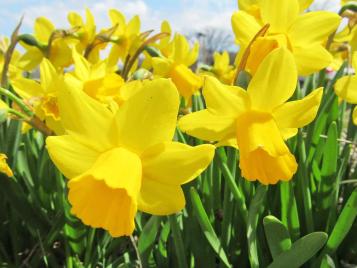
Daffodils bloom in the UK during the spring, but when they bloom depends on variety, winter chilling and seasonal weather patterns as well as soil conditions. This can be anywhere between mid-February and the beginning of May. Some varieties of narcissus also bloom before others: for example, February Gold (as the name suggests) flowers early as it thrives through mild winters, while Thalia and Actaea tend to bloom later, in April.