
Tackling weeds in paths and patios
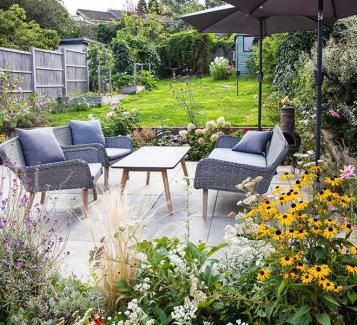
Almost every garden is accompanied by hard surfaces around it, whether that be paths up to your house and around your garden, a patio at the rear of your property, or a driveway at the front.
It might seem that these man-made surfaces are resilient enough to withstand the challenges that nature might throw at it… but that underestimates just how persistent weeds can be!
All year round, annual weeds, perennial weeds and grasses can all become a nuisance, growing in the soil and sand below your path, and finding ways to sprout to the surface and thrive.
Getting rid of these weeds is important for the health of your hard surfaces, especially if they represent a substantial financial investment. Addressing them by hand can be time-consuming, back-breaking work, so you may find using a weedkiller is the easier, more comprehensive option.
This guide explores how to get rid of weeds between hard surfaces, including the best driveway weedkiller and other products to use, and how to get the best possible results.
Which types of weeds grow in paths and patios?
The weeds that thrive best in and around hard surfaces are the hardier types, as it takes a lot more determination for them to come through in challenging conditions. Naturally, paths and patios don’t make for optimal growing conditions, as access to light and water is restricted compared to normal soil, and so weeds don’t tend to grow as large or take root as deeply.
Weeds that may grow through hard surfaces can include (and are not necessarily limited to):
- Annual meadow grass
- Chickweed
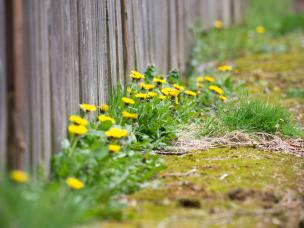
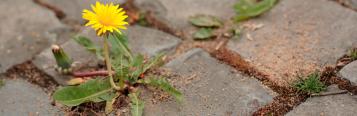
- Dandelion
- Oxalis
- Plantain
- Speedwell
If you’re unsure what type of weed is growing through your path or patio — or indeed, if you’re unsure whether it’s a weed at all — then this article can help you identify what you’re dealing with.
Should I remove all weeds from hard surfaces?
Not necessarily. In some cases, you may feel that a certain weed — especially one with an attractive flower — actually brightens up the look of your path or patio, and perhaps just needs some management to keep it under control.
But there are some very good reasons to look at path and patio weed removal, beyond anything that looks unsightly. If large numbers of weeds start to grow extensively, it can cause some structural damage to the paving, and potentially render it cracked and uneven. The knock-on effects are an increase in erosion as more water is able to seep through, which accelerates damage further.
How to get rid of weeds between paverS
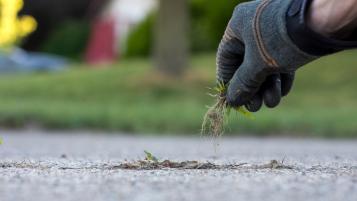
If you’ve decided to look at weed removal from your hard surface, you should first look at the quickest and simplest ways to get rid of them. If there are relatively few weeds that are only in localised areas, then taking them out manually makes more sense. But, as you’ll read here, there are other tactics you may want to consider:
Expose the weeds
Exposing the weeds to kill them off can be simple, fast and effective. On looser gravel surfaces, hoeing under the surface on a warm day can expose roots to dry air and kill them off. In cracks, a weeding knife running along the length of the crack can cut off roots, before the hook is used to extract the weed — and the same principle can be used on dandelions and docks, too.
Re-point your paving
Loose pointing is a popular location for weeds to break through hard surfaces, so filling these in periodically can make a real difference. A brush and chisel can remove the old pointing, ready to be replaced by a jointing compound or dry mortar mix.
Apply a weed membrane
Weed membranes work very well in protecting flower beds and borders from weeds, and the same applies to gravel paths and patios, too. Applying a membrane film beneath the stones but above the soil or rock below creates a layer that weeds can’t get through, preventing them from gaining the nutrients they need to grow.
Seal gaps in the surface
If weeds are growing through gaps between paving stones or cracks in tarmac, then sealing off those gaps with tarmac sealant or sand can provide a stronger weed-resistant barrier. This sealant may only need to be reapplied once every few years, and so will protect the surface from both weeds and the weather in the longer-term. This is a particularly good option for driveways, when there is a substantial financial investment to protect.
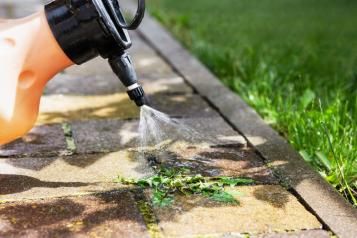
What’s the best weedkiller for patios and hard surfaces?
If you have substantial weed coverage in many different areas, then many of the tactics mentioned above can be time-consuming and hard work. What’s more, digging can often ruin a surface, while you can’t always guarantee that you haven’t left pieces of root behind, from which weeds can regrow.
In this situation, using driveway weedkiller or a similar weedkilling product is much more effective and comprehensive — but it’s important to use the right weedkiller in the right way, depending on the environment involved. These are your potential options:
Algaecidal detergents
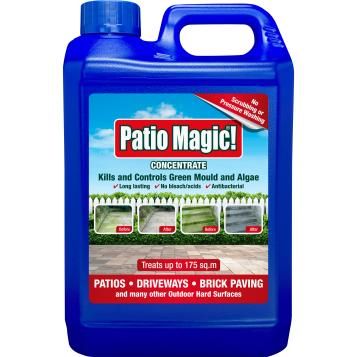
This is the best product to use for hard patios or paths that have problems with algae and/or mould. Patio Magic! Concentrate is perfect for killing mould, algae and mildew on hard surfaces and helping to prevent re-growth for many months — all without the need for manual scrubbing or pressure washing.
Glyphosate-based weedkillers
Many general-purpose weedkillers will kill the weeds and grasses that appear on gravel drives, paths and between the slabs of patios. Some of them contain glyphosate, a systemic weedkiller that slowly kills all weed growth, including the roots.
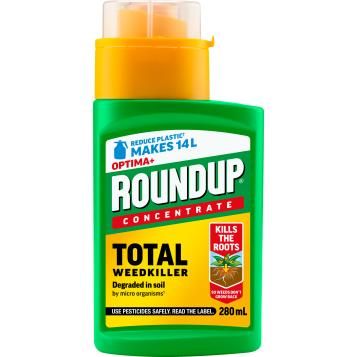
Glyphosate-based weedkillers such as Roundup Optima+ Concentrate can be used in most areas of the garden (except the lawn), and any treated areas around hard surfaces where you want to encourage growth (such as borders) can be re-seeded or planted after seven days.
However, while this is the most universal option, it isn't the most effective in hard-surface environments, largely because any seeds around can still germinate straight after the treatment.
Path-specific weedkillers
The best results that will kill existing weeds is a product specifically designed for the task. For example, Roundup Weedkiller Path Optima is a glyphosate-free solution that starts working within a few hours and naturally breaks down in the soil beneath the hard surface. Best applied on a warm, dry day, it works best on young weeds, but can be applied again to kill off larger weeds.
Getting the best results with driveway weedkiller
In order to get the best results from your weed removal using weedkiller, we recommend the following:
Choose a dry day
As many weedkillers go in through the leaves, you should apply it on a dry day, as any rain might wash it straight off. If rain falls shortly after application, a further treatment may be needed.
Don’t agitate the soil after applying
The systemic effect of the weedkillers may be reduced if you try to remove the top growth before the weed has died back naturally. Allow a few weeks after treatment for the weed root to be killed completely before removing the dead foliage, or just leave the weed to decompose naturally.
Resist the temptation to rake
Avoid raking over the treated areas as much as possible as this may break up the residual layer and seedlings may pop up.
FAQs
When is the best time to use weedkiller on hard surfaces?
You can apply at more or less any time from spring through to autumn (as long as the weather is dry). The best time is in spring when the existing weeds are growing strongly and before too many new seeds have germinated.
What’s the best tool for removing weeds from block paving?
Hand tools like hoes and weeding knives work well for removing weeds from paths, patios and block paving. For more specific weeds, you could also consider a specialist weed-pulling tool that can help you tackle the roots as well as the plant.