

Caterpillars
What are caterpillars?
Caterpillars are the larvae stage in the life cycle of butterflies and moths. Because many caterpillars eat leaves, some species are serious plant pests – one of the most common garden caterpillars, that of the cabbage white butterfly, for instance, can devastate brassica crops.
Where do caterpillars come from?
Caterpillars start off as eggs laid by moths and butterflies, often on plant leaves. When they hatch, their primary purpose is to eat those leaves (and in some cases, fruit and flowers) to stimulate their growth before their metamorphosis phase. This is the point when they form a cocoon to live inside, from which they will later emerge as a moth or butterfly.
Caterpillar identification UK
There are numerous types of caterpillars in the UK. With many different sizes, colours and textures, garden caterpillar identification can be tricky.
-
Several caterpillar types thrive on cabbages and other brassica plants. These include:
-
Yellow/green striped caterpillars with black markings are the larvae of large cabbage white butterflies, which lay clusters of yellow eggs on the undersides of brassica leaves. The eggs hatch into 5cm long caterpillars.
-
Pale green caterpillars covered in short, velvety hairs are the larvae of small cabbage white butterflies.
-
Yellow/green or brown/green caterpillars with smooth bodies are the larvae of another brassica pest, the Cabbage moth, which lays white, spherical eggs.
-
A green caterpillar with distinctive black stripes the length of their bodies is becoming more common in our gardens. It’s the box tree caterpillar, sometimes called simply the box caterpillar, as the box is its favoured food.
-
Black and orange striped caterpillars are the larvae of the red and black Cinnabar moth. They are dangerous caterpillars for birds because they build up their poison by feeding on their favourite food, ragwort. Their bright colours warn predators that they’re poisonous. Cinnabar moths can be seen flying during the day and night and are often mistaken for butterflies.
-
Black caterpillars covered in long black and ginger hairs are often called 'woolly bears'. The larvae of the garden tiger moth, they feed on stinging nettles, dock leaves and many garden plants, as well as a range of weeds and grasses. The adult moth has brown and white patterned wings in front with bright red and black spotted hindwings.
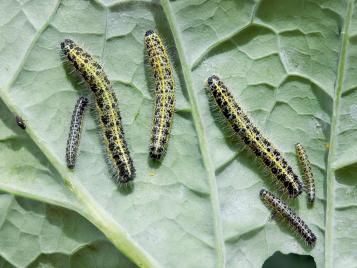
Caterpillar damage
Most caterpillars are active in spring and summer. Large cabbage white butterfly caterpillars eat holes in the leaves of cabbages. The caterpillars of the small cabbage white butterfly and the cabbage moth tend to feed at the heart of cabbages. Box tree caterpillars produce webbing over their feeding area and can strip a box plant of all its leaves.
How to stop caterpillars eating my plants
The first step is to check susceptible plants like cabbages and box (Buxus sempervirens) regularly from early summer to early autumn. Once you see caterpillars, you should take action immediately to minimise the damage, starting by picking eggs and caterpillars off the leaves by hand, and moving them to a site where any impact won’t be as harmful. As they often feed at night, doing this in the dark with a torch may be more effective.
If you choose a biological method, use a control consisting of a mixture of pathogenic nematodes, including Steinernema carpocapsae. The nematodes enter the caterpillars’ bodies to infect them with a bacterial disease. Spray the product directly onto the caterpillars during damp weather at least three times to control the population. It should be noted, however, that biological methods will work better on some caterpillar species than others.
If none of these methods work, then the answer is to spray with a contact and systemic insecticide. For best results, spray at the first sign of infestation and re-apply when necessary.
Before you treat caterpillars on fruit and vegetables, always check that the insecticide is approved for use on edible crops. To protect bees and pollinating insects do not apply to plants when in flower. Do not use where bees are actively foraging. Do not apply when flowering weeds are present.
How to stop caterpillars eating my plants naturally
If you don’t want to affect your plants by using insecticides, there are more natural alternatives. For example, you could attract natural caterpillar predators into your garden with food and nest boxes: hedgehogs eat caterpillars, as do birds such as bluetits, great tits, blackbirds and robins.
For brassica crops like cabbages and sprouts, you can also use fine netting or horticultural fleece to prevent adult butterflies and moths from laying eggs on the crop. Make sure the netting does not touch the plants because the adults can lay eggs through it.


