What are thistles?
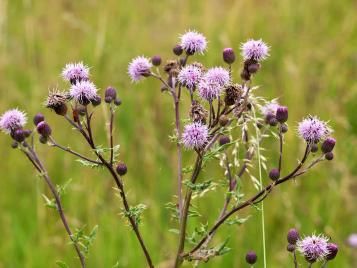
Creeping thistle (Cirsium arvense) is a common garden weed in lawns and borders. It forms clumps of prickly leaves and tall stems with pinky-purple flowers that produce fluffy wind-borne seeds. As well as a deep tap root, creeping thistle has lateral roots that spread out sideways under the ground, producing buds that develop into new plants.
Identifying thistles
Thistles are of course easy to identify to the touch, although a little painful – make sure you watch out for the prickles. The overlapping bracts found directly below their flowers are always spiny. This makes it a simple process of identification compared to their many relatives in the daisy family. Depending on the species of thistle, the density of spine coverage and the size and shape of leaves will vary. Some even have soft prickles.
Creeping thistle produces dense spines on its leaves – you will however find very few spines or hairs on their flowering stems. Its pinky-purple leaves flower in July to September. Once the flowers give way, fluffy hairs will be left in their place which are essential for thistle seed dispersal – one of the biggest reasons why creeping thistle spreads quickly and easily.
Thistle damage
Creeping thistle spreads quickly in lawns and borders, both through seed dispersal and via its lateral roots. It competes with other plants for water and nutrients.
You’ll find that creeping thistle also regenerates easily from broken pieces, whilst its seeds germinate readily – this is especially the case when temperatures fluctuate or when they reach between 20-30°C during the day.
Thistles removal and control
If you’re wondering how to get rid of garden thistles, you have a couple of options available. Creeping thistle is difficult to remove by hand, as the lateral roots break easily and new plants will grow from any root segments left in the ground. Using weedkiller will give a quicker result, however non-chemical control can work if done consistently over several seasons.
Getting rid of thistles without chemicals
- The best way to get rid of thistles naturally is to dig up by hand, removing as much of the roots as possible. You will need to do this repeatedly during the growing season, as thistles re-grow from broken-off segments.
- To weaken the plants, cut the stems down at the base once the flowers develop, as the plants will have used up much of their food reserves developing the flowers.
Best weedkiller to kill thistles
- In lawns, apply a selective weedkiller containing clopyralid, such as Weedol Lawn Weedkiller. This will target the weeds without killing the grass.
- In borders, carefully target individual thistles with a systemic weedkiller containing glyphosate, such as Roundup Fast Action. Glyphosate is a non-selective weedkiller and will kill any plant it comes into contact with, so protect other plants in the border by covering them with sheets of plastic.
- Always follow the manufacturer’s instructions when using weedkillers.
How to prevent thistles?
To prevent thistles from growing in your garden in the first place, try the following:
- Mulch new beds thickly with organic material (for example compost) to stop thistle seedlings taking root. The loose texture of the mulch also makes any young weed seedlings easy to pull up.
- Check beds regularly and remove any young thistle seedlings promptly.