How to identify and remove thuggish perennial weeds
Weeds, pests & diseases

How to identify and remove thuggish perennial weeds

You find a weed in your garden. You dig it out, or spray the affected area with weedkiller. Job done… or is it?

If you’re tackling perennial weeds (or woody weeds), this might only be the first chapter of the story.

Perennial weeds can be the bane of a gardener’s life. They can last several years, come back to life even when you think they’ve been dealt with, and can be a constant menace to your lawn, plant beds, paths and patios.

Getting rid of perennial weeds requires careful handling, patience, persistence, and the use of the best perennial weedkiller you can get your hands on. This guide covers the types of perennial weeds in the UK, why they’re so difficult to remove, and how best to destroy them — for good. 

What are perennial weeds?

Perennial weeds are those that have an overall lifespan of more than two years. They grow and bloom each summer, and even though their foliage might die back each winter, their roots retain enough nutrients to survive the winter frosts, so that they can grow back again each summer.

Typical perennial weeds you might find in a UK garden include (and are by no means limited to):

  • Bindweed: very long stems that flower with heart-shaped leaves that are white or pink
  • Bird’s foot trefoil: yellow flowers of five leaves, with long, thin seed pods
  • Black medick: relatively short-lived perennial with rounded yellow flowers and black seed pods
  • Brambles: thick, long stems with clusters of pink or white flowers
  • Couch grass: coarse perennial grass with longer leaves than lawn grasses
  • Creeping thistle: large, tall weed with big spiny leaves, and purple/pink flowers in the summer
  • Dandelions: common yellow-flowering weed that can smother the grass in lawns and germinate all year round
  • Docks: large oval leaves with long seedheads on tall stems
  • Green alkanet: looks like a foxglove when small, with hair stems and large oval leaves
  • Ground elder: a thick carpet of leaves with small white flowers
  • White clover: weed with creamy white flowers that can form large mats of leaves

For more detailed descriptions and pictures of all of these weeds, and other non-perennial weeds that might affect your lawn or garden, read this article on identifying lawn and garden weeds

Why is getting rid of perennial weeds so difficult?

Perennial weeds live longer than any other type of weed, so it’s no real surprise that they are the hardest to get rid of. There are four unique characteristics that contribute to their longevity:


Deep-growing taproots

The root networks of perennial weeds can reach far underground. Which increases the complexity of digging them out, and also increases the risk of damaging the root systems of any nearby plants that you want to keep.


Substantial nutrient storage

Those root systems, often made up of large, thick roots, enable perennial weeds to store large amounts of water and nutrients for the winter months. That way, they’re ready to start growing again as soon as the weather warms up in the spring.


Extensive reproduction

Perennial weeds can reproduce in a number of ways, including roots, seeds, and structures like tubers and rhizomes. The ability to do this year after year allows them to spread far and wide if left untreated in the long term.


Easy regrowth

Not only do perennial weeds tend to grow very large and very quickly, but they can also regrow from very small fragments of detached root. Given how deep and complex those root systems can be, this means perennial weeds often reappear in places where gardeners thought they had been eradicated.


How to remove perennial weeds

Given the hardy nature of perennial weeds, you’ll need all the help you can get to make weed removal as easy and efficient as possible. We recommend the following four tactics: 
 

Choose the right time of year

Weedkillers work best when the weeds are actively growing, as this helps circulate the chemical inside the plant so that the weedkiller takes effect throughout. The best time of year is usually between April to September, depending on the weather and temperature at the time (more on this below).

Dig them out (carefully!)

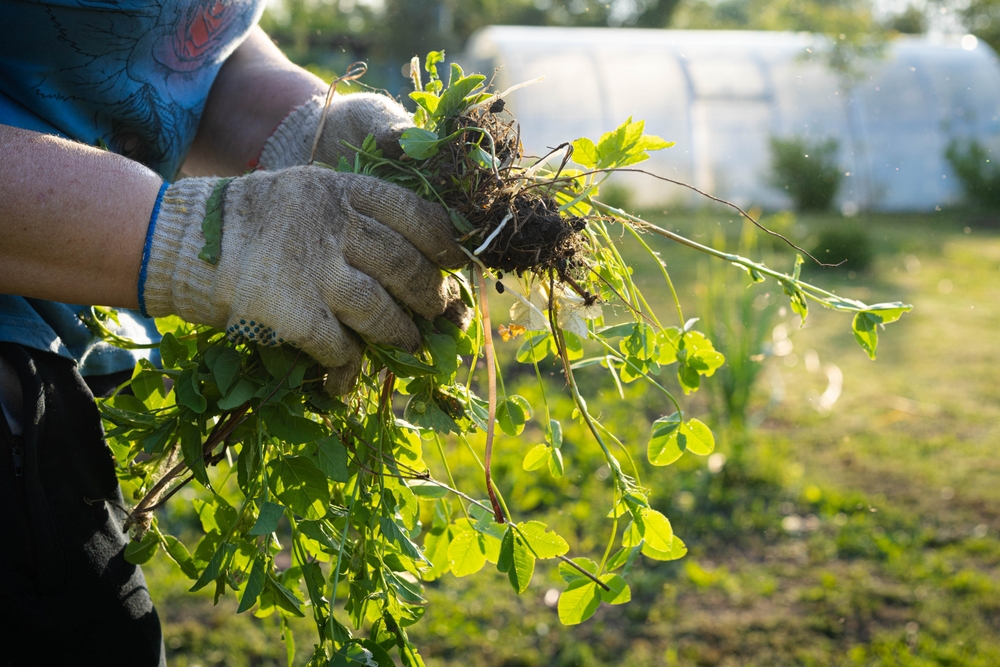
For small numbers of perennial weeds, and those that are small in size and not well-established, try and dig them out manually in the first instance. You can use a spade, a trowel, a hand fork or a specialised weeding tool. Hoeing isn’t particularly effective for perennials, as this simply takes the top growth away, from which they can simply regrow from the roots underneath. 
 

It is critically important that you remove every bit of perennial root you see, as even the smallest pieces left in the ground will grow into a new plant, and start the colonisation of your garden all over again.

Spray with weedkiller at the right time

The more leaves the weed has and the bigger they are, the larger the surface area to spray and the more contact weedkiller that can be applied and consequently absorbed. Weeds with big root systems need a reasonable amount of weedkiller to kill them completely, so spray when they have a lot of fully open leaves, while ensuring no weedkiller comes into contact with flowers.

Make sure you check the weather forecast first, as any rain within six hours of application will wash off some or all of the treatment. And in summer, spraying when the sun is shining means that most of the weedkiller simply evaporates and doesn’t have a chance to be fully absorbed. Waiting until the evening, when it is cooler, means more chemical will be taken up by the leaves.

Bide your time

The absorption into the leaves does take some time, so you need to have something that many gardeners are famous for not having – patience!
 

The initial signs that something has happened can normally be seen within seven to ten days, as the leaves start to turn yellow and die back. Complete control and dieback usually take place in two to four weeks. Sprayed weeds should be left undisturbed for at least a week, and ideally until they are completely dead. 

Which is the best perennial weedkiller?

The best perennial weedkiller for your needs will be defined largely by the environment where the weeds are living:

For flower beds and planted areas

In the areas like flower beds where there are other plants nearby, a contact or systemic weedkiller that can be applied at close range will do the job. However, as these weedkillers are not selective, they will affect any plants they come into contact with, so you should apply them very carefully.

For lawns

Perennial weeds on lawns are best addressed with a selective weedkiller, such as Miracle-Gro Complete 4-in-1. This will attack the weed right down to the root but without harming the grass around it.

For paths and patios

When perennial weeds work their way through the cracks in hard surfaces like paths and patios, use a path-specific product like Weedol Path & Gravel Control. This naturally breaks down into the soil underneath the surface, so that existing weeds are killed, and new seeds don’t get the opportunity to germinate. 

FAQs

Should creeping perennial weeds be treated the same?

Creeping perennial weeds — those that spread through roots and rhizomes close to the surface — can be particularly difficult to get rid of. If they have become established, you may need to use a combination of weedkiller, and manual management such as mowing, hoeing and mulching over a long period of time (possibly even years).

Can you compost perennial weeds?

Yes, although this should be done carefully. Composting may not necessarily kill all the seeds off, which means there is a risk of the weeds growing back, while there is also a risk of contamination or disease transmission through the compost to other plants. You should also make sure the perennial weed isn’t considered controlled waste (for example, giant hogweed or Japanese knotweed).

What if the perennial weedkiller hasn’t worked first time?

Any especially stubborn weeds can be subject to repeat sprayings of weedkiller, but you should make sure not to overdo it. For example, if using Weedol® Gun! Fast Acting Weedkiller, you can reapply as long as you wait at least two weeks between applications, and up to a maximum of four applications per year. Check the instructions on your chosen product carefully if you intend to apply multiple times. 

Find your local store

Looking for specialised gardening advice? Or just hunting for a specific product? Visit your local store and get help from dedicated staff.