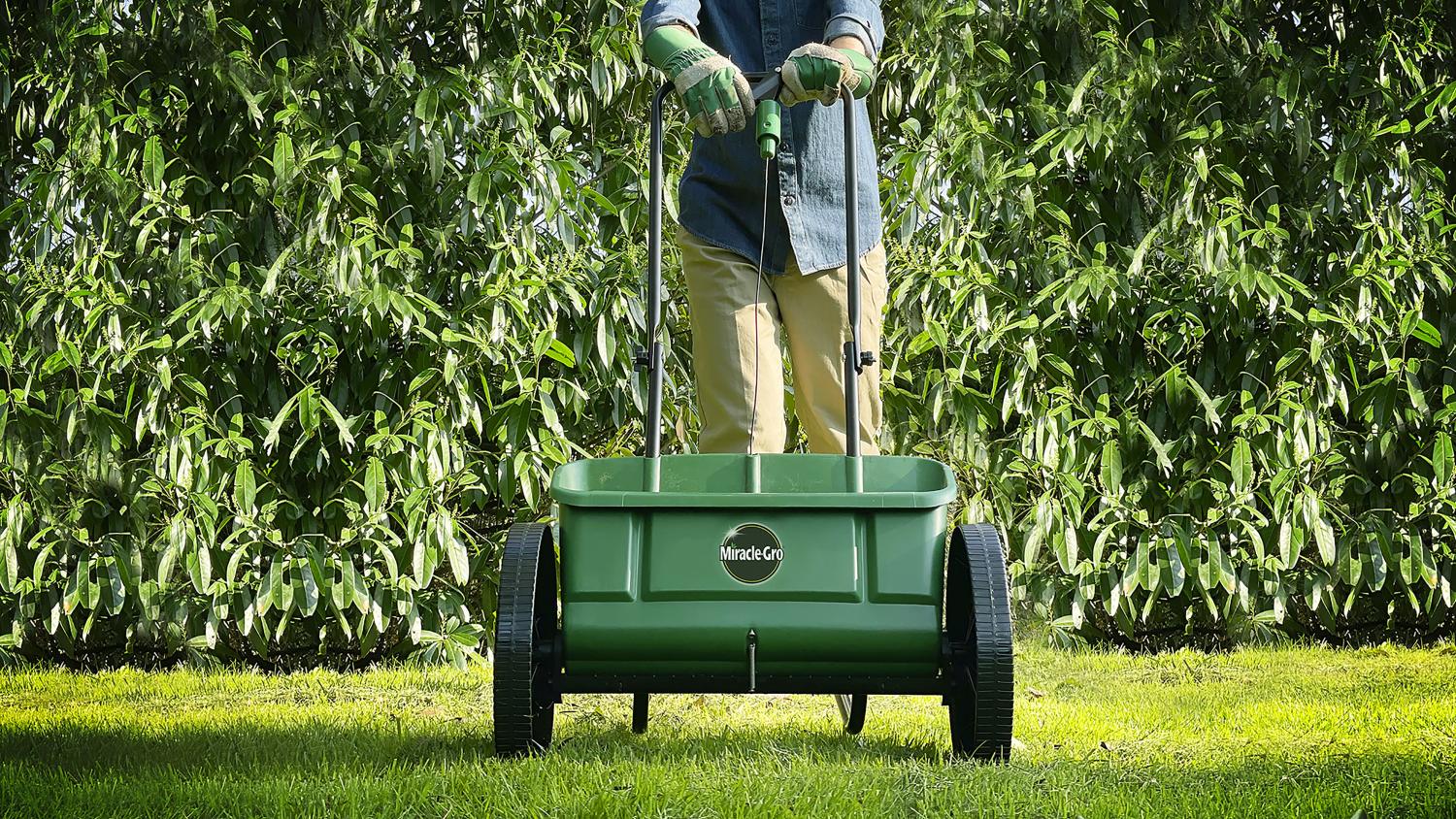


How to sow grass seed for the perfect lawn

How to sow grass seed for the perfect lawn

Confused by different types of grass seed? Our guide will help!

A space for entertaining, a playground for children and pets, a calm space to rest and relax – a lawn can be all of these things and more! Sowing grass seed is an inexpensive way to create a lush green lawn that will give you years of enjoyment in your garden. Our simple guide tells you what’s the best grass seed to choose and how to grow grass from seed into a top-quality lawn.


Why grow a lawn from seed?

  • Growing a lawn from seed has several advantages over laying turf:
  • The amount of seed you’ll need to sow a lawn costs much less than the amount of turf required to cover the same area. 
  • Seeding a lawn is faster than laying turf (although the soil preparation time is the same for both methods)
  • Lawn seed establishes better in shade or in heavy clay soils than turf does, so it’s ideal for these tricky areas. 
  • There’s a wide range of grass mixes available, so you can choose one that’s exactly right for your garden conditions, whether that’s a shady area, a luxurious fine lawn or hard-wearing grass that can cope with children and pets. 
  • Seed deteriorates more slowly than turf, in fact it can last up to two years, so if the weather turns nasty, you can wait a week or two before seeding a lawn, whereas turf needs to be laid soon after delivery.

If you’ve decided that seeding a lawn is the best option for you, your next step is to decide what is the best grass seed for your lawn.
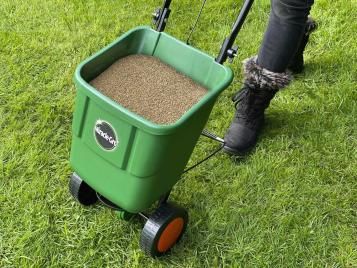
A Miracle-Gro lawn seed spreader filled with grass seed on a lawn.

Choosing the best grass seed for your lawn

Before choosing your lawn seed, think about how you want to use your lawn – will it need to stand up to children playing, parties, and people walking on it regularly, or do you want a close-cropped smooth lawn that just needs to cope with light foot traffic? It’s also important to consider whether the lawn is mostly in sun or shade. Lawn seed mixes contain different proportions of various grass seeds to suit growing conditions and the type of lawn needed. Here are some of the most commonly used grass seeds.

  • Perennial ryegrass (Lolium perenne) is a fast-growing, hard-wearing grass that germinates fast and at lower temperatures than many other grass species. It doesn’t like to be cut too short – a good excuse for mowing less frequently! Perennial ryegrass is often mixed with other finer grasses to produce a lawn that looks good and stands up to hard use. 
  • Strong creeping red fescue (Festuca rubra subsp. rubra) is fine-leaved, spreads by underground rhizomes and is good for filling in bare patches and for coastal gardens. Like perennial ryegrass, it doesn’t like to be cut too short.  Although not particularly hard-wearing, it is drought tolerant, and recovers well after damage.
  • Slender creeping red fescue (Festuca rubra subsp. litoralis) has fine leaves that help to produce thick lawns and can cope with close mowing. It’s shade and drought tolerant and is often combined with ryegrass to produce a good-looking and hard-wearing lawn.
  • Chewings Fescue (Festuca rubra subsp. communata) has fine blades and tufty growth, ideal for creating a luxurious lawn that can be mown very short. It’s not hard-wearing, so needs to be combined with tougher grasses like perennial ryegrass for high-use areas.  
  • Hard Fescue (Festuca trachyphylla) is a drought-tolerant fescue with fine leaves and tufty growth, good for dry or shady lawns. 
  • Smooth stalked meadow grass (Poa pratensis) is both shade tolerant and drought tolerant, so it’s ideal for growing under trees where dry shade is often a problem. It has fine leaves and a spreading habit that helps to produce thick lawns. 
  • Browntop bent (Agrostis capillaris) is a very fine-leaved grass that produces high quality lawns that can be close-mown. It needs regular lawn maintenance to keep it looking good and is not up to hard use unless mixed with stronger grasses like ryegrass or creeping fescue.  It doesn’t grow well in shade.

If you want a hardwearing lawn that will stand up to lots of foot traffic, children and pets playing, then look for a lawn seed mix with a high percentage of perennial ryegrass and strong creeping red fescue, like Miracle-Gro Quick Grow Lawn Seed which has been specially formulated to germinate rapidly.

For shady lawns, choose mixes containing hard fescue and strong creeping fescue, plus slender creeping red fescue and browntop bent for looks.

Luxurious lawn mixes like Miracle-Gro Soft & Lush Lawn Seed are high in browntop bent and Chewings fescue, and these lawns will need annual lawn maintenance to keep them looking good. Applying a lawn feed like Miracle-Gro Complete 4 in 1 to established lawns will boost lawn health and control moss and weeds.



How to prepare the ground for sowing grass seed

Close up of a gardener raking bare soil to level it before sowing seed.

The key to success in sowing grass seed for a lawn is in the preparation. Don’t be tempted to take shortcuts at this stage, as proper preparation will make all the difference to how well your lawn grows and how good it looks in years to come. 

  1. Ideally, start preparing the soil several weeks before you plan to sow your grass seed. Clear the area of all weeds and other vegetation. Dig any perennial weeds out by hand if possible. You may need to use weedkiller for especially tough weeds, but don’t use a residual weedkiller, as this will stay in the soil and stop your grass seed germinating.  We also do not recommend using home remedies, such as salt or vinegar, as these can harm your lawn and prevent your grass seed from germinating too.
  2. Dig the soil over to a depth of 20cm to break up any compacted areas. If you’re preparing a large area for sowing, you may find it easier to use a mechanical rotavator to do this. 
  3. If your soil is very light and sandy, dig in a soil improver such as well-rotted farmyard manure or garden compost. This will improve the soil structure and help it retain moisture in dry periods. 
  4. After digging the soil, leave it to settle for at least several days, and ideally for up to 6 weeks. (This is why it’s a good idea to start preparing your soil early!)
  5. Once the soil has settled, remove any new weeds that have appeared. Rake over the surface of soil in several different directions to level it and to get rid of any large stones or clods of earth. At this stage, it’s a good idea to rake in a general-purpose fertiliser as well.

How to sow grass seed

Gardener sowing grass seed on lawn with a lawn spreader.

Now that the ground is prepared, you’re ready to sow your grass seed.

  1. Check your seed packet to find out the right amount of seed to sow to cover the area you want. Measure the seed out and divide it into two batches.
  2. Sow the first batch of seed using a seed spreader, walking up and down the area to be covered.
  3. Sow the second batch of seed by going side to side across the area, so that you are sowing at right angles to your original batch. This will help you spread the seed evenly.
  4. Cover the seeds with a thin layer of soil, either by gently raking soil over the seeds or scattering soil over the seeds by hand.
  5. If no rain is forecast in the next few days, water the area gently using a fine spray to avoid washing the seeds away. 
  6. If necessary, cover the sown area with horticultural fleece to stop birds eating the seeds, or just sow extra seed to allow for some losses. 
     

How to care for newly-sown lawns

Closeup of new grass seedlings in lawn

  1. Water the sown area every few days unless it rains, using a hosepipe with a fine spray or a watering can with a rose, if your lawn is smaller.
  2. Keep off the grass until it has grown to between 5-7.5cm tall, then gently firm the soil with a roller or tread over it to level any uneven areas. 
  3. Leave it for 2-3 days and then mow on a high setting, taking care to remove no more than one-third of the grass blade length. 
  4. Mow as needed to keep the grass to this length, but otherwise try to keep off the grass as far as possible for at least 8 months, until it is well established.

How to sow grass seed on an existing lawn

Planting grass seed on an existing lawn is called overseeding, and it’s an excellent way to fill in bare patches and thicken up a lawn. It’s simple to do – just follow these steps.

  1. Dig out any perennial weeds with a hand fork or use a lawn weedkiller.
  2. Once the lawn is clear of weeds, mow it on one setting lower than you would normally use, then rake over with a rake to remove any thatch and moss. This allows the new seed to easily reach the soil between the roots of the existing grass.
  3. Aerate the soil to break up any areas of compaction, using a garden fork or a mechanical aerator.
  4. Scatter a light layer of lawn dressing (topsoil mixed with sand) and spread it over the area using a broom or the back of a flat soil rake, working it into the holes made by aeration. This helps to improve soil structure, and also fills in any small dips in the lawn.
  5. Spread the lawn seed in the same way as you would sow a new lawn, in two passes at right angles to each other. 
  6. Rake lightly over the area to ensure the seeds are in contact with the soil.
  7. Water regularly every few days as you would for a newly sown lawn.

FAQs

How should you prepare the ground for grass seeding?

  1. Remove all weeds 
  2. Dig the soil over to break up any compacted areas
  3. On sandy soils, dig in well-rotted farmyard manure to help the soil retain moisture.
  4. Leave the soil to settle for up to 6 weeks.
  5. Remove any new weeds and rake the ground level and clear of stones.

Find your local store

Looking for specialised gardening advice? Or just hunting for a specific product? Visit your local store and get help from dedicated staff.